Skip to content
Key takeaways:
- STRONG Beginnings is Story House Early Learning’s curriculum approach, created around purposeful play, relationships and inquiry-led learning.
- Everyday experiences such as stories, construction, gardening, movement and mealtimes can all support learning.
- Educators intentionally extend children’s interests through questions, resources and shared investigation.
- Learning develops with age, from Stepping Stones for younger children to Pathways to School for older children.
- School readiness includes communication, independence, confidence, problem-solving and early academic foundations.
When your child says they ‘played all day’, what does this tell you about what they actually learned? Under the STRONG Beginnings childcare curriculum at Story House, there’s intention behind all the fun. STRONG Beginnings is the approach we use to turn play, day-to-day routines and each child’s own interests into meaningful learning. This article walks you through what a typical day is like and why even ‘ordinary’ experiences count as learning. You’ll also find out how the approach develops as your child grows. Still, it’s not intended to be a fixed timetable because experiences vary according to age, individual interests and each child’s unique stage of development.
What is the STRONG Beginnings curriculum?
Story House STRONG Beginnings is an early learning approach created around three interrelated ideas, that is, purposeful play, warm relationships and inquiry-based learning. In other words, children are given the time and space they need to explore what they’re curious about. Meanwhile, educators intentionally arrange the environment, ask questions and, as required, add resources to extend the learning.
Inquiry-based learning is the technical name for this process. Children explore questions and test their ideas. They gain understanding through direct personal experience instead of having to work through a predetermined sequence of lessons. Educators observe interests, listen closely, then respond with a question, provide new materials or make a change to the environment to keep the learning moving forward. All this is quite different to unstructured free time.
A single activity can help your child develop several skills at the same time. For instance, when a child plants a seed, they may be learning about cause and effect (science), counting and measurement (numeracy), vocabulary such as ‘roots’, ‘sprout’ and ‘soil’ (language), fine motor control, patience and care for living things (wellbeing). Just one activity leads to many learning threads. Such a day-to-day activity pattern is the best way to explain STRONG Beginnings in early learning settings.
This inquiry-based curriculum in long day care embraces the whole day as an opportunity for learning. There’s no need to isolate learning into a particular time slot for a predetermined lesson. For a deeper dive into play as intentional learning, our companion piece on learning that feels like play explores this at greater length.
What your child does during a STRONG Beginnings day, and why
The picture below represents a STRONG Beginnings day, and doesn’t reflect a fixed routine. Each Story House room organises its day around the particular children who are present, their current interests and the time of year.
Part of the day | What your child might do | What they are learning | STRONG Beginnings connection |
Arrival and settling in | A warm greeting from an educator, family handover and settling into the room with familiar routines and peers. | Belonging, secure relationships, emotional regulation, expressive communication. | Relationships come first. A confident start to the day positively influences the experiences that follow. |
Child-led play and investigation | Blocks, loose parts, sensory trays, puzzles or imaginative play with peers. | Curiosity, problem-solving, negotiation, collaboration, creativity. | Educators observe and join in when helpful. They extend the child’s interests with questions or new resources. |
Stories, songs and language | Group and one-to-one reading, rhymes, storytelling, songs and role-play conversations. | Vocabulary, listening, communication, early literacy and rhythm. | Language learning is a continuous thread throughout the day not confined to a single lesson slot. |
STEM and inquiry experiences | Planting seeds, water play, measuring, building simple structures, investigating insects or observing the weather. | Prediction, observation, numbers, patterns and testing ideas. | STEM resides inside play. Educators bring materials and pose questions that extend a curiosity into an investigation. |
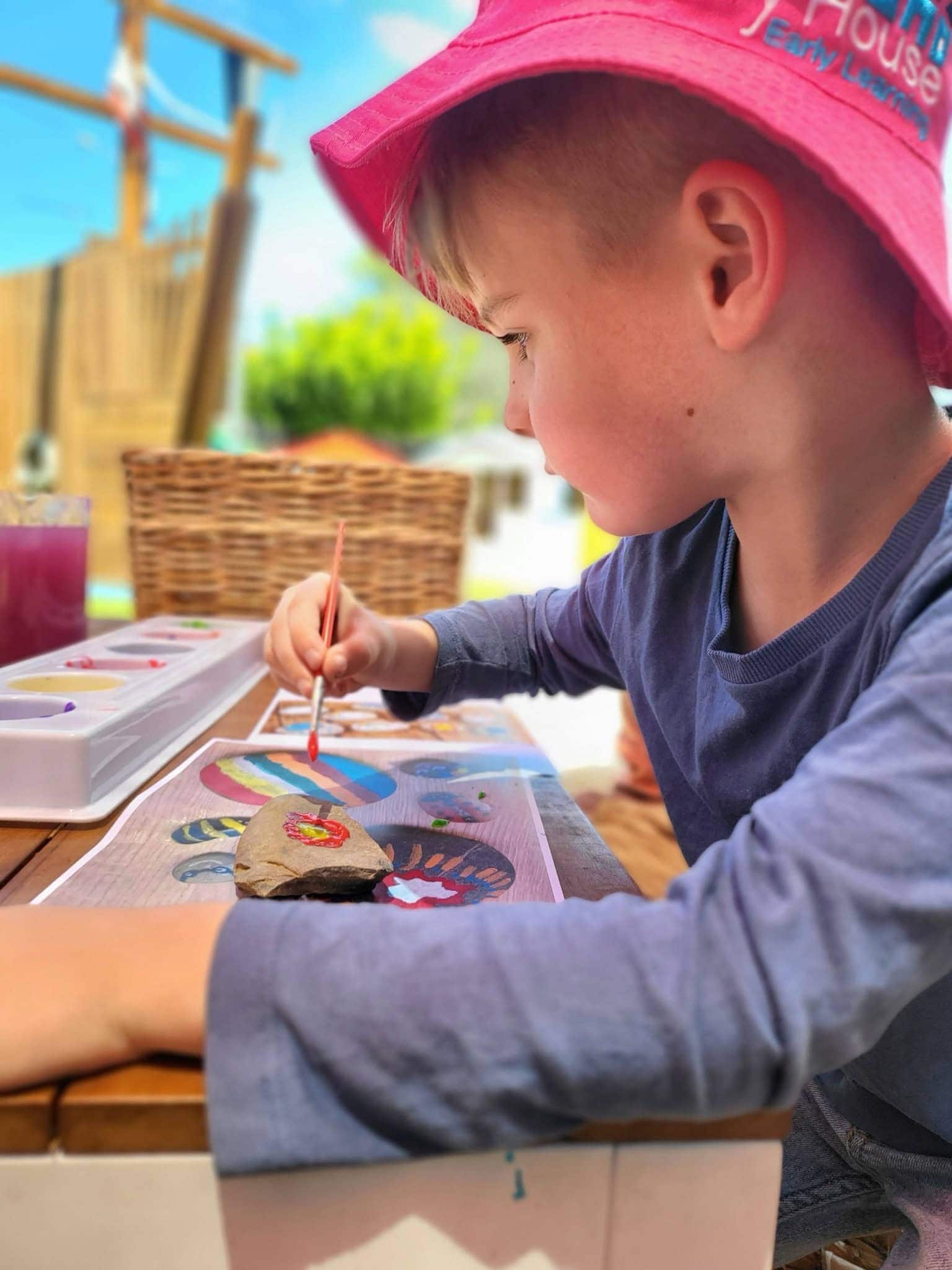
Creative and expressive experiences | Painting, mark-making, music, dance and movement, dramatic play. | Creativity, communication, persistence, coordination, self-expression. | Children can choose their materials and outcomes, and educators make space for the process, instead of focusing only on the finished piece. |
Outdoor play and everyday routines | Nature exploration, physical play, meals, tidy-up and self-help routines such as dressing or handwashing. | Physical confidence, independence, responsibility, wellbeing and social skills. | The ‘routines’ of the day are learning experiences in and of themselves, not gaps in between activities. |
Learning takes place throughout the whole day, not only during planned activities. A conversation over lunch, a spontaneous question at the sandpit, a peer negotiation about who uses the red crayon next, sharing a giggle about something funny. All of these involve learning that educators notice and encourage children to extend.
A few threads run through every part of every day. Educators try to weave language and vocabulary into arrivals, meals, transitions and outdoor play as much as into planned story sessions. Emotions and social skills are supported by naming feelings, offering choices and helping children resolve small disagreements among themselves. Physical routines such as handwashing and packing away are treated as opportunities for children to build the independence they’ll benefit from when they start school.
How STRONG Beginnings changes as your child grows
The overarching philosophy stays consistent from infancy to the preschool years, though the way the day unfolds in a room changes considerably as children develop.
Stepping Stones for Little Feet (birth to three)
For very young children, learning begins with responsive relationships and sensory exploration. Educators know each child well, notice what they’re curious about, respond to their cues throughout the day and note significant milestones. Language and communication develop well before children start speaking fluently, through gestures, expressions, vocalisations and back-and-forth exchanges.
Regular childcare moments count every bit as much as any planned experience. Nappy changes and meal times are opportunities for one-to-one connection, language input and gradual progressions in independence. For a fuller picture of this stage, our Stepping Stones for birth to three article shows you what learning inside a nursery or toddler room can involve.
Pathways to School (three to five)
As children move into the older rooms, inquiry becomes more sustained and children take on more responsibility for the direction of their day. Investigations can now run over several days, as children return to a project, add new ideas, make new observations and compare current outcomes to what happened previously. Communication, collaboration, early literacy, numeracy and creative expression all deepen as children practise them through real, shared experiences instead of being taught as isolated skills.
Small-group and whole-group experiences occur more and more frequently. Children begin to plan and represent their thinking through drawing, dictating stories, building models or documenting their own investigations. Educators support this by asking open-ended questions, introducing new vocabulary and pointing children back to what they noticed earlier.
School readiness is gradually developed through implementing this approach daily, so there’s no need for any formal classroom lessons. In the final year before school, our Pathways to School program focuses more strongly on the practical dispositions and confidence children need to take into their first year of school. This consists of self-help skills, familiarity with routines, ability to communicate needs, persistence with an unfamiliar task and the confidence to try again.
How STRONG Beginnings supports EYLF outcomes and school readiness
The Early Years Learning Framework (EYLF) is the national framework that guides early childhood educators throughout Australia. It sets out the outcomes children should have the opportunities to develop, including belonging, identity, communication and wellbeing.
STRONG Beginnings works side by side with the EYLF. Play-based learning, combined with educator intentionality, supports each of the framework’s recognised outcomes without needing to resemble a school classroom. Language and literacy permeate the day. Our earlier article on how the curriculum nurtures your child’s language development goes over this in detail.
School readiness is more all-encompassing than simply reading, writing and counting. Having the confidence to leave a parent at the door, the ability to communicate a need or feeling, the willingness to attempt something unfamiliar, and feeling comfortable within a group are also part of school readiness. The table below draws on four examples to illustrate this broader definition.
Learning experience | Skill developed | Why it helps with school readiness |
Group stories and songs | Listening, vocabulary, early literacy | Prepares children for listening in the classroom and communication |
Block and construction play | Problem-solving, planning, spatial thinking | Supports early numeracy and persistence with a challenge |
Outdoor investigation | Curiosity, observation, physical confidence | Builds the self-management and stamina needed to get through a full day of school |
Care routines and mealtimes | Independence, self-help, social skills | Helps prevent feeling overwhelmed in new settings and and supports smooth transitions |
The broader aim is to encourage children to become confident, capable learners who arrive at school ready to engage. What this doesn’t involve is rushing children through formal lessons ahead of their time.
Find out more for yourself
The best way to see STRONG Beginnings in practice is to visit a centre. If you’d like to see an example of the SHEL curriculum in action, arrange a tour at your nearest Story House centre. On the tour, you’ll have the chance to ask an educator what the children are currently investigating and how their interests are being extended. Every child’s learning unfolds slightly differently because the curriculum responds to that child’s development, interests and developmental stage. Find a Story House centre near you and arrange your visit.
Frequently asked questions
How do Story House educators decide what activities to plan?
Educators observe children’s current interests, ask relevant questions and take into account their stage of development. They then plan experiences that respond to and extend those interests. Planning draws on reflection, family input and connection to the Early Years Learning Framework rather than to a rigid preset national curriculum.
How do parents find out what their child is learning?
Families can find out about their children’s learning through everyday educator conversations and viewing individual learning documentation. You can also find out more by accessing the centre’s communication practices, such as parent apps and posted programs. Speaking with the room leader during pick-up times is one of the fastest ways to get to know what your child engaged with that day.
Is STRONG Beginnings the same at every Story House centre?
The curriculum framework is shared throughout the Story House network, but individual experiences vary according to the children, educators, local environments and current interests in the room. No two rooms follow an identical program, because the approach is responsive to the children in attendance.
Can STRONG Beginnings support children with different learning needs?
Early childhood learning is inherently responsive to individual development and participation needs. Families with specific requirements or diagnoses should discuss their child’s situation directly with the centre instead of assuming support is identical in every network location.
How can parents continue STRONG Beginnings learning at home?
The best ways to carry the learning over to home include following your child’s questions, reading together, involving them in everyday tasks such as cooking or gardening, and continuing interests that began at childcare. A short conversation about what they enjoyed most that day brings to the surface the areas they want to keep exploring.