Skip to content

Key takeaways
- Inquiry-based learning begins with a question, problem or idea and gives children opportunities to investigate, form explanations and communicate what they understand.
- Inquiry doesn’t need to begin with a spoken ‘why?’. Younger children can communicate curiosity through actions, choices, repetition, exploration and emerging language.
- Inquiry evolves as children develop. Hands-on investigation stays crucial in early childhood, while preschoolers are progressively able to share ideas, explain their thinking, and maintain collaborative projects.
- Child-led inquiry doesn’t imply that educators step back. Instead, educators deliberately create environments, introduce resources, listen to children’s ideas, and expand on child-initiated learning.
- At Story House, Stepping Stones for Little Feet curriculum supports inquiry and exploration from birth to 3 years, while Pathways to School extends inquiry through projects including STEM, technology, engineering and exploring local ecology for children aged 3 to 5.
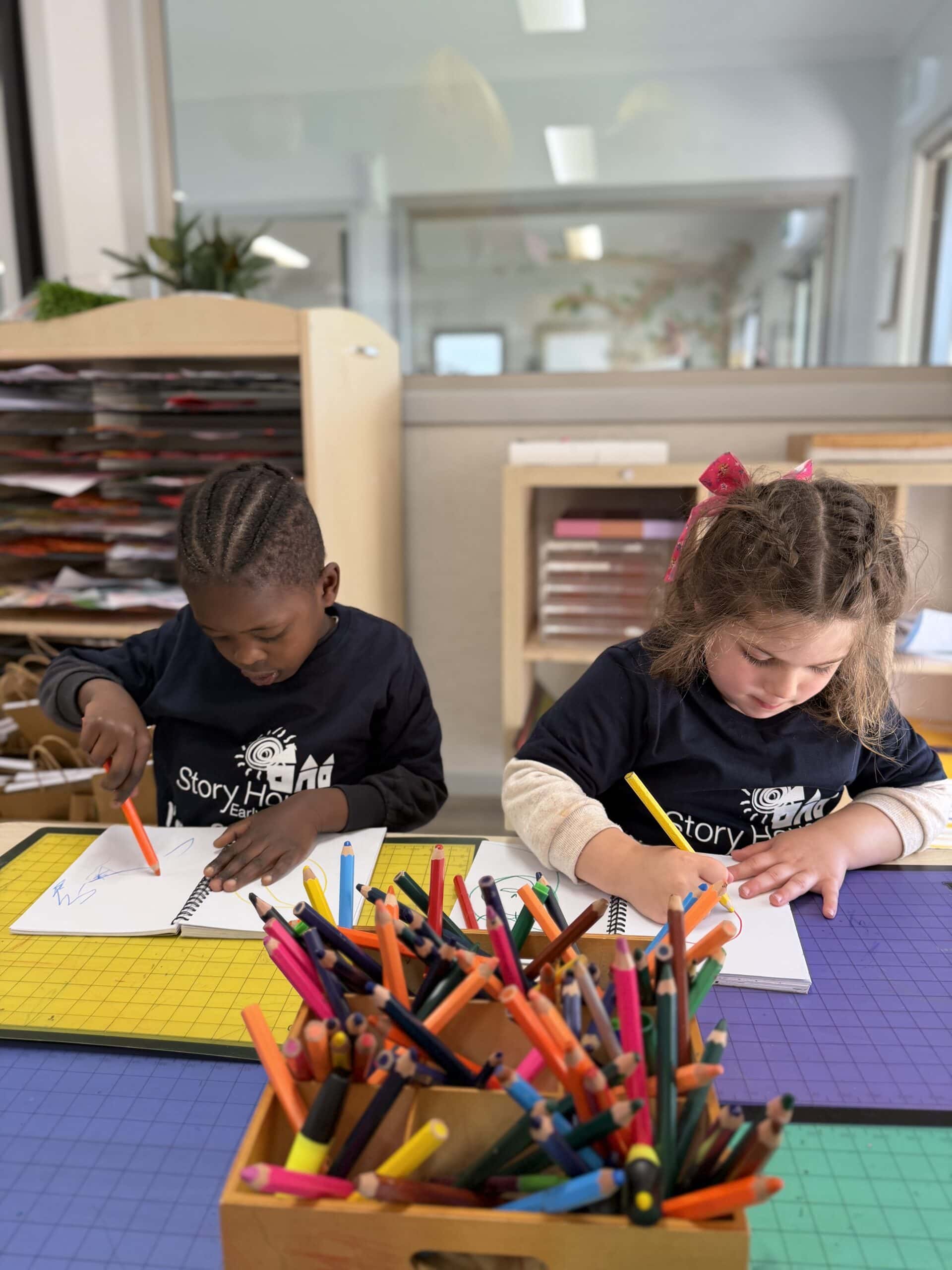
‘Inquiry-based learning’ appears in just about every early childhood centre’s marketing. Yet, this phrase tells you very little about what your child will actually be doing on a regular day. This article draws from conversations with Suzie Wood, Story House’s Head of Early Childhood Education. It looks at how inquiry-based learning in Australian early childhood classrooms may look for children aged 2, 3 and 4. It includes what the child might do, what the educator might do next, and what learning is taking place beneath the playful activity.
Table of contents
• What is inquiry-based learning in early childhood?
• Inquiry learning at age 2, 3 and 4 at a glance
• Seeing it in practice: age 2 to age 4
• If it’s child-led, what is the educator actually doing?
• Why inquiry matters for school readiness
• Frequently asked questions
What is inquiry-based learning in early childhood?
Inquiry-based learning at its core starts with a question, idea, or problem, and then provides children with opportunities to experiment and share their evolving understanding. Queensland’s official inquiry-learning guidance describes the process as children participating in investigation, proposing explanations and expressing what they understand.
In practical terms, your question ‘what is inquiry-based learning in childcare’ comes down to a short sequence. Something captures a child’s interest, the educator notices and offers a conversation or resources to give the child a way to investigate further. This naturally unfolds within the context of play and doesn’t need to be anything that’s formally structured. For the broader definition of inquiry, purposeful play and project-based learning, our earlier piece on building strong foundations through inquiry and play delves into the underlying approach in greater detail.
Inquiry-based learning at age 2, 3 and 4 at a glance
The age-related table below shows a broad progression of inquiry-based learning, but isn’t a developmental test. ACECQA makes it clear that children’s learning is ongoing and doesn’t always progress predictably or in a straight line. That’s why your child may spend more time in some phases than in others.
| Age | What inquiry may look like | Educator’s role | Skills being developed |
| 2 | Exploring directly through movement, objects, repetition, sensory experiences, simple choices and emerging questions. | Watch closely for what the child keeps returning to. Put language around the experience and introduce a safe way to test or extend the interest. | Curiosity, cause-and-effect thinking, emerging language, independence and persistence. |
| STRONG Beginnings example:Children repeatedly engage with a water play tray. Their curiosity develops into asking questions about cause and effect. They explore by pouring slowly, wondering, ‘What happens when I pour slowly’? Or ‘Will it float if I push it’?They learn through hands-on exploration, moving and sensing, repeating actions, making simple choices about which cup to use, where to pour, and what to add, while observing the changes over time. The educator observes what children repeatedly choose and encourages deeper thinking by describing their actions and observations. They explore new words like ‘float’, ‘sink’, ‘spill’, ‘measure’ and ‘tilt’. This encourages curiosity, cause-and-effect understanding, and emerging language skills such as questioning and explaining. It also fosters independence and persistence, as shown when children try again after different results. Children develop problem-solving skills through repetition and experimentation. | |||
| 3 | Increasing use of language, imaginative play and peer interaction to ask questions, suggest ideas and investigate something together. | Help children put their thinking into words, introducing new materials or vocabulary. Give an interesting idea time to continue beyond a single activity. | Communication, collaboration, prediction, problem-solving and flexible thinking. |
| STRONG Beginnings example:Children learn about babies’ needs and growth through stories, imaginative play and peer interaction. Educators ask questions such as “Why does a baby cry?” and “How does a baby learn to move?” while sharing children’s thoughts and ideas on empathy and caring for babies through activities like sleep, tummy time, using soft blankets, and baby-care props.Educators help children articulate their thoughts by introducing new vocabulary like grows, nurture, gentle touch, nappy, milk, caring, and cuddling. They also foster turn-taking conversations where children expand on each other’s ideas. When a question such as “What helps babies sleep longer?” arises, the inquiry extends beyond a single activity, continuing throughout the day. Children revisit the play area to test their ideas using safe materials, and they contribute pictures, labels, and new words to the group’s shared baby-care “learning” display. | |||
| 4 | Longer shared investigations where children make predictions, represent ideas, compare what happened and return to a project over several days. | Extend children’s thinking through intentional questions, new information, resources, documentation and connection to concepts such as STEM or literacy. | Critical thinking, communication, persistence, collaboration and increasing independence. |
| STRONG Beginnings example:During a longer shared investigation at our nature play area, children discovered an ‘ant tunnel’ near a tree root and started predicting what might live beneath it. Over several days, they expressed their ideas through drawings, simple maps showing bug locations, and notes like ‘small legs’ and ‘no smell’. When they revisited the site, some children compared observations (like more ants on the shaded side and fewer in the sunny area) and discussed possible reasons for these changes.They repeatedly returned to the tree, using new tools like magnifying glasses and soil scoops. Prompts like ‘How could we test that?’, ‘What would happen if…’ and ‘Where can we find out more’ from teachers helped children connect their observations to STEM concepts like plant habitats, food chains and cause-and-effect. They also developed literacy with words and phrases like ‘I predict…’ and ‘I noticed…’.As they worked together, children took on roles such as ‘finder’, persevered through mistakes, and became more independent by planning further observations and explaining their ideas. This developed critical thinking, communication, persistence, collaboration, and early scientific inquiry. | |||
Seeing it in practice: age 2 to age 4
Age 2
A 2-year-old doesn’t need to articulate a question for inquiry to take place. A child can be testing an idea by repeating an action, transferring water between containers, or returning to the same material. The educator’s role is to encourage the child to keep that action going without disruption. They notice the pattern, add a new word or phrase, make another resource available and then let the child experiment. Our Stepping Stones curriculum describes this stage as one where curiosity and hands-on discovery are the drivers.
Age 3
The curriculum for 3-year-olds works as a bridge rather than a distinct new step. Children gradually start contributing more verbal ideas, building on a peer’s suggestion, or explaining what they think may have happened. The educator holds the inquiry open longer by revisiting an idea a day later, adding a resource that reframes the question, or connecting the interest to another learning domain. [Verified age-3 SHEL example from Suzie to be inserted here.]
Age 4
By the age of four, a single inquiry can span several sessions. A sequence to look out for is interest, educator response, investigation, the child’s new thinking and the next extension. This sequence makes intentional teaching more evident beneath what might otherwise seem like play. Our Pathways to School curriculum page describes the types of extended-inquiry projects children participate in. [One confirmed age-4 example from Suzie to be inserted here, without implying every 4-year-old completes the same project.]
If it’s child-led, what is the educator actually doing? (and how this fits with play)
‘Child-led’ refers to children’s autonomy and influence over learning, and isn’t an absence of teaching. ACECQA describes child-directed practice as educators creating opportunities for children to make choices, with their ideas incorporated into planning. Children are encouraged to persist with activities and extend their learning. child-led inquiry learning for children are to:
• Notice what the child is interested in, not what an adult expects them to focus on.
• Listen to their language and repeated choices.
• Offer a question or resource that reframes the interest.
• Record their thinking to encourage ongoing inquiry.
• Consider where the learning might develop further and modify the environment accordingly.
Inquiry and play-based learning occur simultaneously. The Early Years Learning Framework (EYLF) describes play-based learning as involving intentional roles for children and educators. Story House embodies that integrated perspective in our inquiry-based play approach. Our companion piece on learning that feels like play covers this intersection in more detail.
Why inquiry is important for school readiness
School readiness depends more on learning dispositions than early academic tasks. As an active educational approach adopted throughout Queensland, autonomy, decision-making, collaboration, problem-solving and independence are highlighted as key benefits of inquiry. A child who persists despite facing challenges, communicates ideas, listens, makes choices, and tries new approaches practices skills that pave the way for future learning.
The STRONG Beginnings inquiry learning curriculum from Stepping Stones for little feet into Pathways to School continues this thread through literacy, numeracy, wellbeing and transition learning. School readiness shouldn’t be judged by how ‘academic’ an early learning room appears.
See inquiry-based learning for yourself
The best way to understand inquiry is to find out for yourself. On a centre visit, ask an educator about a recent inquiry in your child’s potential room, including where the interest started, children’s contributions, what educators added, and what the team observed. Find your nearest Story House centre to arrange a visit.
Frequently asked questions
What is inquiry-based learning in childcare?
Inquiry-based learning is an approach where questions, ideas, interests or problems instigate investigation. Children actively explore instead of just receiving answers, as educators provide questions, resources, and experiences to expand their thinking.
What does inquiry-based learning look like for a 2-year-old?
Inquiry at age two occurs through actions as well as language. Repeating experiments, investigating objects, testing cause and effect, or revisiting interesting things reveal what a child wants to know. Story House’s Stepping Stones curriculum encourages curiosity and hands-on exploration during the birth-to-3 stage.
What does an educator do during child-led inquiry learning?
Educators observe children and support their interests by listening, introducing resources, and extending experiences. ACECQA’s guidance highlights the importance of incorporating children’s ideas, supporting their choices, and encouraging persistence to extend learning.
How does inquiry-based learning help prepare a child for school?
Inquiry gives children opportunities to practise problem-solving, decision-making, communication, collaboration, persistence and independence. Story House’s Pathways to School program combines inquiry-based projects with broader literacy, numeracy, wellbeing and transition learning to support the move into schooling.